
NIMSUC VARGAS INTERVIEW
By Catalina Castillo
Nimsuc Vargas, is a Colombian Costume Designer from the Hamburg State Opera, today, he talks about his experience and his collaboration from the costume production process at the opera.
Since his arrival in Germany 10 years ago, his creative process has been linked to experimentation with textiles and the contribution of modern techniques such as 3D printing, mixed with other craft techniques in the development of costumes for set design. His penchant for crafts and performing arts developed when he decided to specialize in costume design at the Hamburg University of Applied Sciences.

“I enjoy telling stories and visual narratives through objects and costumes”
Why do you like costume design?
I have always had an interest in crafts and performing arts. I like to tell stories and visual narratives through objects and costumes.
How did you come to work at the Hamburg State Opera?
In Colombia, my interest and experience had only been in classical theater, while lyrical theater and opera had always seemed unattainable to me, especially in Colombia, it was in Germany where I saw an opera and a musical for the first time, this aroused in my greatest fascination.

During my master’s degree, I had the opportunity to collaborate with creatives from different fields who helped me expand my perspective on performing arts and the different media and formats possible. Another factor that prompted me to get involved in opera was the language. While I was finishing my master’s thesis, I started doing internships in various theaters, theater, and opera projects.
Although I understood and spoke the language well enough to be able to live, study and work in Germany, I realized that it was easier for me to understand and enjoy an opera and a ballet than a play. After several internships in 2019, the Hamburg Opera offered me to be part of the Costume team.

Tell us about your work team. How do you manage to materialize a costume production and at the same time be coordinated with your production team?
When I work as a designer, the director generally has a basic idea about the work he wants to do, this is discussed with the playwright and the other creatives depending on the project (set designer, musical director, audiovisual, etc.) and thus the general concept is formed. Of the work with which each one begins to work.
My work begins by researching and collecting references and images to be able to visualize the aesthetics of the project and then start making the designs that are later discussed with the team and modified. Finally, when we all agree on the designs, I begin to produce them, sometimes by myself, and on other occasions with the collaboration of external workshops.
Another perspective on my work is with the production team of the opera, we work with an external designer who presents us with the final designs for a production. We discuss the designs and possible production methods, we choose materials together and coordinate the work with our workshops (dressmakers, shoemakers, etc.).

Any work anecdote that has challenged you as a designer?
I worked as a wardrobe assistant for Nabucco. The editing was by a famous Russian director because he not only directs, but he also designs his own sets and costumes. It was a very large production, it had been planned at least a year in advance, that opera was performed with a full choir, an extra choir and a children’s choir, approximately 130 people on stage.
A few months before the rehearsals were to begin, the director was arrested in Moscow and sent to jail. The production decided to continue with the editing and give the director the opportunity to finish the editing remotely. It was interesting to see how we rehearsed and did costume fittings in the afternoon, everything was recorded and sent to a lawyer who was the only one who could Having contact with the director, he finally received and watched the videos at night and sent his notes the next day.
It was very interesting to see how such a large production basically depended on contact and became a broken telephone game, especially noting that this was before the pandemic when the home office in the performing arts was almost unimaginable.

“I try to take inspiration especially from cinema and fashion, but currently I have a particular interest in music and especially concept albums”
What inspires you in terms of creative development?
I try to take inspiration especially from cinema and fashion, however, currently I have a particular interest in music and especially concept albums. An example is Beyonce with her latest album Renaissance: is an album that is inspired by House / Dance music and celebrates club and queer African American Culture. I had the opportunity to see her tour and I was fascinated to see how he takes references from the music and its context and mixes them to form a very clear and precise aesthetic universe. I bought the book that documents part of the tour process as a souvenir, and I have it on my worktable where I see it almost every day.
Tell me about some work you have done that represents you a lot.
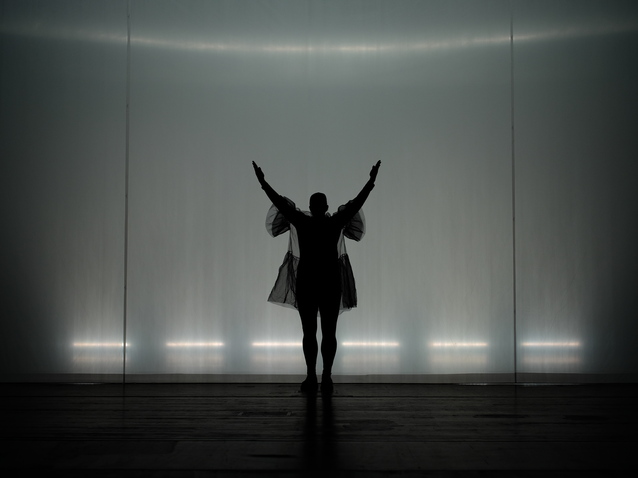
My Master’s Degree Project was very important to me, the thesis was: ephemeral intimate spaces in the LGBTIQ+ subculture, it was the first time I dared to make a production where I did everything: costume design, stage design, directing and create music. A detail that also makes this project special is that except for some photos necessary for the project, there is no record of the performance.

About the inclusion of traditional techniques in costume making and the support you have provided with new techniques in 3D. How has this challenge been?
One reason I like working on costume production in opera is because of the hard work with respect to the (technical) tradition you have with manual labor and the variety of craftsmen and different talents on the team.
It was very interesting to learn from them but at the same time to be able to support them with my knowledge of modern techniques and promote the digitization of the department. We currently work together trying to combine techniques such as digital printing and hand painting or 3D printing with manual modeling, among others.
Do you think that investment is needed in academic programs in Colombia that promote education in specialization with topics related to design and art?
Yes, in Colombia there is a lot of talent, however, the lack of government support, there is a lot of wasted talent. The current situation in the country makes it very difficult to have a career in art or theater. For this reason, I also decided to study here, there is state support for an entire theater industry, there is greater artistic freedom to be able to develop projects that one is passionate about, all kinds of theater can be produced, and this industry does not depend on ticket sales.
Deja una respuesta